
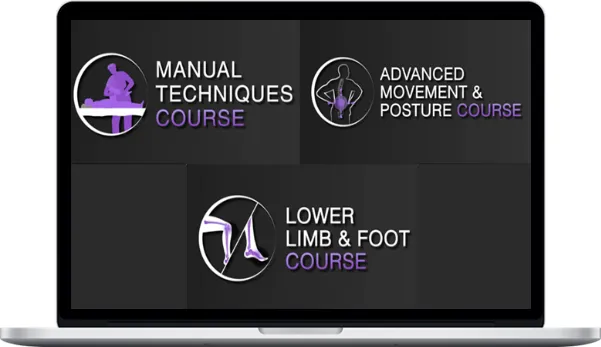
Conor Harris – Course Bundle
Lower Limb & Foot Course + Manual Techniques Course + Advanced Posture & Movement Management Course
Lower Limb & Foot Course
A course designed to help you improve dysfunction at the knees, ankles, and feet, and integrate that better movement into the entire body’s movement cycle
What is the Lower Limb & Foot Course?
This course dives deep into the biomechanics of the knee, ankle, and foot. While we will address these areas during the Biomechanics Course, we don’t have enough time to go into enough detail of these areas in the depth that is necessary to fully understand them.
Many times throughout the course, you will hear me say “If they have a foot issue, then they won’t be able to progress until they address that.”
This course is designed exactly for those cases.
This is because some clients will have posture or movement dysfunctions that start at the foot and lower limb. Their foot cannot interact with the ground in the way that is necessary for them to properly distribute forces and allow the rest of the body to access certain positions with gait and any movement where the foot has to work with the ground (which is most things we do as humans!).
The #1 Complimentary Course to the Main Biomechanics Course
I say this is the most important supplement to the main course for a good reason.
The course is designed to be a full-body approach to fixing our posture and movement dysfunctions from head-to-toe, because our whole body is involved with every step we take. We can work on trying to align the body in a better way and fixing issues at the hips, trunk, or even shoulders. But if you have a foot-specific issue, then as soon as you start walking, you will immediately start losing progress because your foot won’t allow the rest of your body to do what it needs to.
Our foot’s relationship with the floor is key to getting the rest of the body moving effectively and efficiently.
I think this course is essential because it will help you fix the more complex cases, which you will inevitably run into.
It is designed to perfectly complement the Biomechanics Course and the assessments and model within it.
Program Syllabus
Module 1: Lower Limb Biomechanics & Assessments
- Learn the key anatomy of the lower limb & foot
- Learn high-level biomechanics regarding the knee, ankle, and foot and how they work within human movement and gait
- Understand specifically how dysfunctions specifically at the foot and lower leg can influence posture and limit the rest of the body from moving well
- Introduce simple biomechanical and muscular-strength tests to identify limitations in biomechanics and function of the knee, ankle, and foot.
Module 2: Corrective Exercise Selection
- Learn how to pick the proper corrective exercise for the lower limb & foot specific to the needs of the invidiual
- Progress those corrective exercise through multiple phases of coordination & loading
- Seamlessly integrate the model of progression from this course with the main Progression Model from the Biomechanics Course
- Learn how to select the optimal type/model of shoewear to best complement the needs of an individual’s feet and fix their dysfunctions
- Learn how to modify shoewear through implementation of certain tools designed to improve foot and lower limb function in a given pair of shoes
Module 3: Strength Training & Connective Tissue Health
- Learn how to modify traditional strength training exercise to bias better biomechanical positions & changes at the foot
- Learn how connective tissue (tendons, ligaments, etc) are a key element, and often a missing link in rehab, to improve function and health within the lower limb and foot
- Integrate the nature of how muscles, connective tissue, and joint biomechanics interact and how we can optimize them working together in a rehab program
- Learn specific progresses and regressions for foot, ankle, and lower limb strengthening activities that complement the corrective exercises learned in Week 1
Manual Techniques Course
A course designed to teach you highly effective hands-on techniques that help unlock mobility & range of motion
What is the Manual Techniques Course?
The Manual Techniques course will give you powerful tools to create meaningful changes in your clients’ bodies that will ensure greater success with non-manual techniques (corrective exercises) in the main Biomechanics Course.
It is quite common to have a client that is so stiff and so locked up, that no amount of stretching or foam rolling is going to get the job done to create enough muscle length or “space” for improvement.
Or we have a client where they are not very “in touch” with their own body and they struggle to get into certain positions without compensation because they don’t know how to navigate more complex corrective exercises on their own.
In these cases, manual techniques are absolutely essential to create a window of opportunity.
A Powerful Tool For Complex Cases
This course will give you the tools to unlock so much more potential to help more complex clients. For example, let’s say you had a client that struggle to shift into their hip, so their low back and knee was taking too much load and stress.
You tried some corrective drills and/or stretches, but that hip doesn’t seem to want to open up to allow them more space to shift into that side and load it.
Using a hands-on technique to help open up some space within the hip with then allow you to teach them non-manual corrective techniques where they can educate their body how to use that space.
That’s the magic of manual techniques. They create space for you to then take advantage of that new space to educate better movement. That’s how we get the changes to stick.
In collaboration with a high-level Physical Therapist, James Guzman, we have created a library of manual techniques all designed to improve joint position, muscular length, and create more overall opportunity for movement without as much compensation.
Solutions For Every Area Of The Body
Each manual technique has::
Specific contexts for when it should be used (i.e. when their assessment results or posture present a certain way)
Contraindications (when you shouldn’t use the technique)
4k video quality, clear instructional walkthroughs including common mistakes to avoid
Recommended follow-up non-manual techniques to ensure optimal adaptation and to help the results stick long-term
There are several sections of manual techniques, including the:
- Cranium & Cervical Spine (head/neck(
- Ribcage
- Shoulders
- Pelvis
- Knees
- Ankles
- Feet
Advanced Posture & Movement Management Course
An advanced course that progresses your biomechanics skillset to the next level
What is the Advanced Posture & Movement Management Course?
This course is designed as a “progression” from the original Biomechanics Course. Think of this the “Advanced Biomechanics Course”.
As a collaboration with Applied Integration Academy, we will dive into more advanced biomechanical related concepts that help identify issues with posture and pain.
A Progressed Method Of Understanding Biomechanics
In the Biomechanics Course, you will learn a specific assessment protocol that assesses passive table test measurements to help identify limitations in range of motion and how they relate to posture. In this course, we introduce a new, dynamic assessment.
This dynamic assessment is key because it identifies specific deficits and limitations in one’s ability to properly shift into one side of their body and out of that side. Think gait!
Applied Integration Academy presents on exactly what is necessary (on an advanced level), what it takes to properly “own” the ability to shift our center of gravity into one side of our body, then the other.
They then show three different case studies taking the individual through full assessment and intervention to show you exactly how you can implement the concepts on your own.
Program Syllabus
Week 1: Principles of Gait and Grounding
- Explain the key aspects of the gait cycle required to properly own the ability of shifting from side to side
- Lay out a total-body approach and perspective as to how humans shift into predictable postural dysfunctions
- Introduce the concept of proper “grounding” and how our relationship with the ground affects joint and muscular position from head-to-toe
Week 2: Static Assessments & Interpretation
- Review the previously learned tests in the Biomechanics Course and relate them to the new, advanced concepts of grounding and proper center of gravity shifting in the gait cycle
- Introduce new static, passive table tests that help identify specific limitations in range of motion
- Relate the new table tests to the gait cycle and also prior tests learned in the Biomechanics Course
Week 3: Dynamic Movement Assessment
- Introduce the new “dynamic” movement assessment, which has 5 “levels”. All represent different, but specific, limitations and dysfunctions
- Integrate the dynamic test and interpretation of results with the previously learned passive tests in this course and the Biomechanics Course
- Demonstrate the new tests in several different contexts and individuals
Week 4: Exercise Selection
- Strategically pick corrective exercises that best fit the individual’s needs based off of the integrated understanding and results from both the passive and active tests
- See corrective interventions applied in three different case studies
- Learn how to troubleshoot exercise selection and how to modify cueing to ensure the best results for the client
More courses from the same author: Conor Harris
Related products
Fitness – Gym

Nutrition – Dieting
Fitness – Gym
Fitness – Gym
Fitness – Gym
Yoga – Meditation
Nutrition – Dieting